Wednesday, November 18, 2009

Everything You Need to Know About Writing Successfully - in Ten Minutes, by Stephen King

I'm posting this here because Mr. King is so very right. And, I have so much to learn.

Preach on Mister King!


This comes courtesy Sevastian Winters.
Fan him, he likes it.


Everything You Need to Know About Writing Successfully - in Ten Minutes, by Stephen King

"Everything You Need to Know About Writing Successfully - in Ten Minutes"

by Stephen King (reprinted in Sylvia K. Burack, ed. The Writer's Handbook. Boston, MA: Writer, Inc., 1988: 3-9)

I. The First Introduction

THAT'S RIGHT. I know it sounds like an ad for some sleazy writers' school, but I really am going to tell you everything you need to pursue a successful and financially rewarding career writing fiction, and I really am going to do it in ten minutes, which is exactly how long it took me to learn. It will actually take you twenty minutes or so to read this essay, however, because I have to tell you a story, and then I have to write a second introduction. But these, I argue, should not count in the ten minutes.

II. The Story, or, How Stephen King Learned to Write

When I was a sophomore in high school, I did a sophomoric thing which got me in a pot of fairly hot water, as sophomoric didoes often do. I wrote and published a small satiric newspaper called The Village Vomit. In this little paper I lampooned a number of teachers at Lisbon (Maine) High School, where I was under instruction. These were not very gentle lampoons; they ranged from the scatological to the downright cruel.

Eventually, a copy of this little newspaper found its way into the hands of a faculty member, and since I had been unwise enough to put my name on it (a fault, some critics argue, of which I have still not been entirely cured), I was brought into the office. The sophisticated satirist had by that time reverted to what he really was: a fourteen-year-old kid who was shaking in his boots and wondering if he was going to get a suspension ... what we called "a three-day vacation" in those dim days of 1964.

I wasn't suspended. I was forced to make a number of apologies - they were warranted, but they still tasted like dog-dirt in my mouth - and spent a week in detention hall. And the guidance counselor arranged what he no doubt thought of as a more constructive channel for my talents. This was a job - contingent upon the editor's approval - writing sports for the Lisbon Enterprise, a twelve-page weekly of the sort with which any small-town resident will be familiar. This editor was the man who taught me everything I know about writing in ten minutes. His name was John Gould - not the famed New England humorist or the novelist who wrote The Greenleaf Fires, but a relative of both, I believe.

He told me he needed a sports writer and we could "try each other out" if I wanted.

I told him I knew more about advanced algebra than I did sports.

Gould nodded and said, "You'll learn."

I said I would at least try to learn. Gould gave me a huge roll of yellow paper and promised me a wage of 1/2¢ per word. The first two pieces I wrote had to do with a high school basketball game in which a member of my school team broke the Lisbon High scoring record. One of these pieces was straight reportage. The second was a feature article.

I brought them to Gould the day after the game, so he'd have them for the paper, which came out Fridays. He read the straight piece, made two minor corrections, and spiked it. Then he started in on the feature piece with a large black pen and taught me all I ever needed to know about my craft. I wish I still had the piece - it deserves to be framed, editorial corrections and all - but I can remember pretty well how it looked when he had finished with it. Here's an example:

(note: this is before the edit marks indicated on King's original copy)

    Last night, in the well-loved gymnasium of Lisbon High School, partisans and
Jay Hills fans alike were stunned by an athletic performance unequaled in school
history: Bob Ransom, known as "Bullet" Bob for both his size and accuracy, scored
thirty-seven points. He did it with grace and speed ... and he did it with an odd
courtesy as well, committing only two personal fouls in his knight-like quest for
a record which has eluded Lisbon thinclads since 1953....

(after edit marks)

    Last night, in the Lisbon High School gymnasium, partisans and Jay Hills fans
alike were stunned by an athletic performance unequaled in school history: Bob Ransom
scored thirty-seven points. He did it with grace and speed ... and he did it with an
odd courtesy as well, committing only two personal fouls in his quest for a record
which has eluded Lisbon's basketball team since 1953....

When Gould finished marking up my copy in the manner I have indicated above, he looked up and must have seen something on my face. I think he must have thought it was horror, but it was not: it was revelation.

"I only took out the bad parts, you know," he said. "Most of it's pretty good."

"I know," I said, meaning both things: yes, most of it was good, and yes, he had only taken out the bad parts. "I won't do it again."

"If that's true," he said, "you'll never have to work again. You can do this for a living." Then he threw back his head and laughed.

And he was right; I am doing this for a living, and as long as I can keep on, I don't expect ever to have to work again.

III. The Second Introduction

All of what follows has been said before. If you are interested enough in writing to be a purchaser of this magazine, you will have either heard or read all (or almost all) of it before. Thousands of writing courses are taught across the United States each year; seminars are convened; guest lecturers talk, then answer questions, then drink as many gin and tonics as their expense-fees will allow, and it all boils down to what follows.

I am going to tell you these things again because often people will only listen - really listen - to someone who makes a lot of money doing the thing he's talking about. This is sad but true. And I told you the story above not to make myself sound like a character out of a Horatio Alger novel but to make a point: I saw, I listened, and I learned. Until that day in John Gould's little office, I had been writing first drafts of stories which might run 2,500 words. The second drafts were apt to run 3,300 words. Following that day, my 2,500-word first drafts became 2,200-word second drafts. And two years after that, I sold the first one.

So here it is, with all the bark stripped off. It'll take ten minutes to read, and you can apply it right away ... if you listen.

IV. Everything You Need to Know About Writing Successfully

  1. Be talented

    This, of course, is the killer. What is talent? I can hear someone shouting, and here we are, ready to get into a discussion right up there with "what is the meaning of life?" for weighty pronouncements and total uselessness. For the purposes of the beginning writer, talent may as well be defined as eventual success - publication and money. If you wrote something for which someone sent you a check, if you cashed the check and it didn't bounce, and if you then paid the light bill with the money, I consider you talented.

    Now some of you are really hollering. Some of you are calling me one crass money-fixated creep. And some of you are calling me bad names. Are you calling Harold Robbins talented? someone in one of the Great English Departments of America is screeching. V.C. Andrews? Theodore Dreiser? Or what about you, you dyslexic moron?

    Nonsense. Worse than nonsense, off the subject. We're not talking about good or bad here. I'm interested in telling you how to get your stuff published, not in critical judgments of who's good or bad. As a rule the critical judgments come after the check's been spent, anyway. I have my own opinions, but most times I keep them to myself. People who are published steadily and are paid for what they are writing may be either saints or trollops, but they are clearly reaching a great many someones who want what they have. Ergo, they are communicating. Ergo, they are talented. The biggest part of writing successfully is being talented, and in the context of marketing, the only bad writer is one who doesn't get paid. If you're not talented, you won't succeed. And if you're not succeeding, you should know when to quit.

    When is that? I don't know. It's different for each writer. Not after six rejection slips, certainly, nor after sixty. But after six hundred? Maybe. After six thousand? My friend, after six thousand pinks, it's time you tried painting or computer programming.

    Further, almost every aspiring writer knows when he is getting warmer - you start getting little jotted notes on your rejection slips, or personal letters . . . maybe a commiserating phone call. It's lonely out there in the cold, but there are encouraging voices ... unless there is nothing in your words which warrants encouragement. I think you owe it to yourself to skip as much of the self-illusion as possible. If your eyes are open, you'll know which way to go ... or when to turn back.

  2. Be neat

    Type. Double-space. Use a nice heavy white paper, never that erasable onion-skin stuff. If you've marked up your manuscript a lot, do another draft.

  3. Be self-critical

    If you haven't marked up your manuscript a lot, you did a lazy job. Only God gets things right the first time. Don't be a slob.

  4. Remove every extraneous word

    You want to get up on a soapbox and preach? Fine. Get one and try your local park. You want to write for money? Get to the point. And if you remove all the excess garbage and discover you can't find the point, tear up what you wrote and start all over again . . . or try something new.

  5. Never look at a reference book while doing a first draft

    You want to write a story? Fine. Put away your dictionary, your encyclopedias, your World Almanac, and your thesaurus. Better yet, throw your thesaurus into the wastebasket. The only things creepier than a thesaurus are those little paperbacks college students too lazy to read the assigned novels buy around exam time. Any word you have to hunt for in a thesaurus is the wrong word. There are no exceptions to this rule. You think you might have misspelled a word? O.K., so here is your choice: either look it up in the dictionary, thereby making sure you have it right - and breaking your train of thought and the writer's trance in the bargain - or just spell it phonetically and correct it later. Why not? Did you think it was going to go somewhere? And if you need to know the largest city in Brazil and you find you don't have it in your head, why not write in Miami, or Cleveland? You can check it ... but later. When you sit down to write, write. Don't do anything else except go to the bathroom, and only do that if it absolutely cannot be put off.

  6. Know the markets

    Only a dimwit would send a story about giant vampire bats surrounding a high school to McCall's. Only a dimwit would send a tender story about a mother and daughter making up their differences on Christmas Eve to Playboy ... but people do it all the time. I'm not exaggerating; I have seen such stories in the slush piles of the actual magazines. If you write a good story, why send it out in an ignorant fashion? Would you send your kid out in a snowstorm dressed in Bermuda shorts and a tank top? If you like science fiction, read the magazines. If you want to write confession stories, read the magazines. And so on. It isn't just a matter of knowing what's right for the present story; you can begin to catch on, after awhile, to overall rhythms, editorial likes and dislikes, a magazine's entire slant. Sometimes your reading can influence the next story, and create a sale.

  7. Write to entertain

    Does this mean you can't write "serious fiction"? It does not. Somewhere along the line pernicious critics have invested the American reading and writing public with the idea that entertaining fiction and serious ideas do not overlap. This would have surprised Charles Dickens, not to mention Jane Austen, John Steinbeck, William Faulkner, Bernard Malamud, and hundreds of others. But your serious ideas must always serve your story, not the other way around. I repeat: if you want to preach, get a soapbox.

  8. Ask yourself frequently, "Am I having fun?"

    The answer needn't always be yes. But if it's always no, it's time for a new project or a new career.

  9. How to evaluate criticism

    Show your piece to a number of people - ten, let us say. Listen carefully to what they tell you. Smile and nod a lot. Then review what was said very carefully. If your critics are all telling you the same thing about some facet of your story - a plot twist that doesn't work, a character who rings false, stilted narrative, or half a dozen other possibles - change that facet. It doesn't matter if you really liked that twist of that character; if a lot of people are telling you something is wrong with you piece, it is. If seven or eight of them are hitting on that same thing, I'd still suggest changing it. But if everyone - or even most everyone - is criticizing something different, you can safely disregard what all of them say.

  10. Observe all rules for proper submission

    Return postage, self-addressed envelope, all of that.

  11. An agent? Forget it. For now

    Agents get 10% of monies earned by their clients. 10% of nothing is nothing. Agents also have to pay the rent. Beginning writers do not contribute to that or any other necessity of life. Flog your stories around yourself. If you've done a novel, send around query letters to publishers, one by one, and follow up with sample chapters and/or the manuscript complete. And remember Stephen King's First Rule of Writers and Agents, learned by bitter personal experience: You don't need one until you're making enough for someone to steal ... and if you're making that much, you'll be able to take your pick of good agents.

  12. If it's bad, kill it

    When it comes to people, mercy killing is against the law. When it comes to fiction, it is the law.

That's everything you need to know. And if you listened, you can write everything and anything you want. Now I believe I will wish you a pleasant day and sign off.

My ten minutes are up.

(The above article is copyright Stephen King, 1988)


Friday, November 13, 2009

Friday the 13th


That's right, today is one such superstitious mark on the calendar. Movies have been made about it. Signs and t-shirts are sold to commemorate it. Some people celebrate it like it's a holiday. What is so special about this day, and where did the lore find it's root?

Allow me to begin by saying there is really no clear, viable answer to that question. Like a lot of superstitions, it is based in myth, myths of many different, old cultures that tended to have the same superstitions, for many of the same reasons, though having never met one another. (Which is a fact I always find somewhat unnerving.)

There are many texts that begin with a fear of Friday unto itself, not necessarily Friday the 13th. My first example is brought to you by Chaucer's masterpiece the Canterbury Tales, c.14 A.D. because I am, after all, a book geek. Chaucer had this to say, 'On a Friday fell all this misfortune.' I wouldn't say Friday is a bad day because of Chaucer, but it did leave people of the age to refrain from long journeys that begin on a Friday. Could you imagine this in today's world?

Numerology. I love it. I won't go into my 23 not-really-obsessed-by-fascinated Discordia diatribe. I will however point out the number twelve has long been believed to be a whole number, a complete number: 12 signs on the Zodiac, 12 hours on a clock, 12 Apostles of Jesus, 12 tribes of Israel, 12 gods in the Olympic Pantheon, and so on.

(Now, if you recall, there was a thirteenth person at The Last Supper. I'm just saying.)

Most historians say the fear of Friday the 13th didn't really come into play until the 19th century. I would like to take you all back before that time, way before that time, to probably the most infamous Friday the 13th there ever was. Picture if you will:

The Knights Templar reigned supreme for two hundred years throughout Europe. The Order began after the first of the Christian Crusades, when eight men bandied together to 'help' pilgrims safely visit The Holy Places. They were the very first holy men to also carry weapons in the West. The Pop granted them such leeway, he said the group were free to roam without borders, paid no taxes, and would be subjected to no authority other than that of the Pope himself.

Well, you can imagine what two-hundred years of seizing land, money, and other assests without regard for law or country could do to a group of men, regardless of their faith. The Templars beacme exceedingly wealthy during this time, and highly trained for battle. (So much for remaining poor, humble monks.)

Friday, October, 13, 1307. France.

The Knights Templar were trying to become their own 'state within a state,' and King Philip wasn't having any of it. ON this fateful day he rounded up the Templars and tortured them, accusng the Order of one hundred different crimes, along with Pope Boniface, including devil-worship and denying Christ.

Hundreds of men were brutally tortured .

And it all began....702 years ago..... Friday, the 13th.

Monday, November 9, 2009

National Novel Writing Month!

I'm participating in the NaNoWriMo this month, where the goal is 50,000 in 30 days. That's 1667 words a day and you have GOAL!

Tuatha and the Seven Sisters moon is officially released, and I am STILL participating. Why, you may ask? part is for the challenge of it, also there's the support I'd like to offer my fellow writers who can't seem to organize their thoughts to put words into their books.

I"m getting pretty caught up in the piece I'm writing. It's not something I'd normally write, as it holds a lot of personal feelings within the pages. The setting is my hometown of Niles, Ohio. And the emotions aren't really stirred by that fact alone, it's something else. Things that are bout to be committed to paper, a fictional paper at that, yet are based in truth. Memories, to be exact.

I'm a little torn about this story. I have two other books I've worked so hard on: the second in the Tuatha series and the first in my Blue Moon series. This story, however, is always picking at my attention, pulling away my thoughts, trying for it's chance to meet paper.

I've altered many things to make it a truly fictional story, so no one from back home needs to worry. Even still, there's an element to it that haunts me. Dreams. Are they really our subconscious speaking to us?

Sometimes, I hope that's not true.

Thursday, October 29, 2009

Tuatha and the Seven Sisters Moon BOOK BLITZ


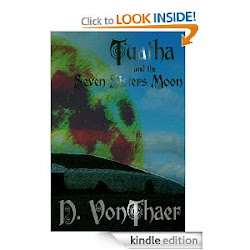
Halloween is almost here, and I'm doing a final home-stretch Book Blitz for my upcoming novel, Tuatha and the Seven Sisters Moon. It debuts on Halloween, and is currently available for pre-order through Amazon. The Limited Edition is available only through my website, and it will never be sold in stores. What's unique about this book? First, it holds a secret chapter that will never be reprinted. The cover is a dedication to this chapter, and to my former home of Salem, Mass. Each hardback copy will be personalized and signed, and the price includes shipping and handling.


PRESS RELEASE:

It's only a few days before trick-or-treaters line the streets, and the much-anticipated launch of Tuatha and the Seven Sisters Moon by new author D. VonThaer. The first question asked seems to always be, "What is your book about?" The natural response would be 'mythology' but somehow that doesn't seem to cover all of the bases. It doesn't even quite get to first. Imagine asking Frank L. Baum [The Wonderful Wizard of Oz] the same question and receiving this for an answer, "Witches."

Tuatha and the Seven Sisters Moon is the first in the Tuatha series, and the story begins on Halloween, where a full moon lights the way for trick-or-treaters. The Seven Sisters Constellation meets the moon at midnight, paving the way for sleeping legends of the past to awaken. The story begins with the Tuatha De Danann [The People of Danu] of ancient Ireland mythology, and what happens when the stars, literally, align.

What's particularly goose-bump producing is the modern take on the story, and the real-life events that have been woven into the story. For example, every ancient culture believed the Seven Sisters Constellation is synonymous with catastrophe. A full moon on Halloween? It doesn't happen as often as you'd think. In fact, the last time this happened was in 2001. Is your skin tingling yet?

The twenty-three chapter 418 page tome is packed with emotion, friendship, love, and devastation. It's very clear this volume is only the tip of the proverbial iceberg in the Tuatha series. It sets you up for things to come, and leaves you wanting more. It's thought producing prose and graphic imagery allows you to sink your reading teeth into vivid scenery, and open your heart to the characters drawing you in page after page.

The paperback edition is available for pre-order through Amazon and will be hitting other retailers next week. The limited edition is ONLY available through the website while supplies last. There will never be a re-printing. The secret chapter will never be published in any other format.

Pick up a copy of this limited edition and hold onto a literary gem that will be a collector's item in a few short years. Once they're gone, they really are just that: gone. Every copy will come with a matching bookmark, and anyone who participates in this Book Blitz will receive free promotion back as a grateful thank-you. Please e-mail dayna@dvonthaer.com for more information.


Orders for this edition had been closed, but I have opened it again for several reasons: people asking me if it's still available, and to highlight the launch of the book on Halloween. Please visit my website, or the publisher's website for more information.

*To participate in this book blitz, simply copy and paste the URL to this blog and share it wherever you can: blogs, Twitter, Facebook, Myspace, as often as you can. Would you like me to contribute to your website or blog? I'd love to! Just drop me an e-mail, I am all about reciprocation and helping my fellow artists. For those who participate all weekend, I have special promo that I'm offering. Please e-mail me for details. dayna@dvonthaer.com

Witches/Cloaking the Truth


{The above images are representative of the stereotypes associated with Witchcraft. What had been a blemish on our earliest society, the perpetuated MYTH, and the REAL Witch of today.}

When I lived in Salem, Mass, my daughter would often come across real witches. Some were dressed in their witchy best; flowing robes in plum and burgundy, high collars and their necks adorned with pentacles or gemstones to appropriate their mood of affection. Others, were very commonly dressed, and looked like any other person walking the street. The ones who were dressed up during Haunted Happenings always got his from her:

"Are you a good witch, or a bad witch?"


I know most witches will cringe reading that. Not one did in person. They thought it was funny, comical, and honest. Almost all of them said, "Well, what do you think?" Her answer? "I think you're good because you smile, and smiling is nice."

She was about four at the time. And, she hit it spot on. They were smiling. They were kind. They answered her curious questions and, like so many others, stroked her platinum hair fondly. At age four my daughter knew the difference between good and bad, kind and mean. She didn't need a symbol to be worn around the neck, or a lecture in what makes a good person. Smiling to her, means you have to be good. And, she was quite right.

My four-year-old knew what grown people never seem to learn.

Today's first post comes from a friend of mine, a talented author and gifted Witch, JoLynne Valerie. She has several blogs about Witchcraft and Paranormal Activity. Her new book, A Tale for All Seasons is OUT. She talks to us about the myths of the Witch and the false impressions many so-called educated and learned people carry with them to this very day.

You can find JoLynne and more information on her book on Facebook, Myspace and Twitter.

JoLynne
:

The mainstream concept of Witches has been used to fuel a massive campaign designed to demonize and subordinate women. This same campaign was used and continues to be used, to secure lands, and political or religious power. To those who have acted in this campaign I would say: IT'S OVER.

The tides are now turning. Many people are stepping forward to let the world know that Witches - real ones, mind you - have always been here, we are most often the "good guys" and we are more powerful than ever.

Ours is a path of peace, however when aligned with the elements and the Divine, our human and spiritual potential is realized. Past campaigns will not be successful against the modern day Witches. Now, we are evolved. And together, we are strong.


NOTE: This is not a comprehensive discussion of the global WitchCraft or Wiccan movement. Nor am I speaking to all the current issues, perspectives or streams of thought. This Note was inspired by a comment from a Facebook friend this morning. I hope my words inspire or affirm those who are meant to be.


PLEASE SHARE YOUR THOUGHTS. If you have anything to add or commentary you'd like to share, PLEASE DO. This topic belongs to many. Your experiences and beliefs are welcome.

Wednesday, October 28, 2009

What is Witchcraft?

In the spirit of Samhain, I've invited friends of mine to elaborate on the often misunderstood religion of Witchcraft. Each has something different to say, and each has a voice that should be heard. Having lived in Salem, I've met MANY practicing witches. And, I can tell you from experience, I've never met a 'bad' one. The myths about witches, paganism, and Wicca are so very old and to be frank, riddled with ignorance.

If I wanted to know what childbirth is like, I'd ask a mother, not a man. Not even a doctor can accurately describe that duality of pain and love unless she has experienced it. Furthermore, if I wanted to know about Judaism, I'd speak to a Rabbi, not a Buddhist monk. If I was curious about the Presbyterian Church, I wouldn't contact a Catholic priest, would I? So, I'm asking witches, real ones, about the Craft, about their feelings, and about the myths and lies that know no bounds.

I'd like to reiterate, acknowledging I sound like a broken record, that witches are NOT evil. They are not devil worshipers. They do not believe in the devil, let alone worship something/someone they do not believe exists. So sit back, have a cup of tea, and open your mind to something called TRUTH.

Our first post comes from my friend Rosalinda of Wick-N-Wax:

Like love, Witchcraft is different for each person. Witch is probably one of the most difficult words to define. Its usage and etymology are shrouded in the deep of history. We cannot provide a definitive explanation, but we are aware that some of our visitors have never met a Witch. We frequently hear the same questions so we'd like to answer some of the most popular ones.

Do Witches believe in God?
Most Witches believe in a creative force that has both masculine and feminine properties and powers. Frequently, we refer to the "Goddess and God" to describe this energy in a way that the human mind can process. Witches use various pantheons from around the world to symbolize the forces of deity. Some Witches do not practice the religion of Wicca; instead, they practice the Craft as an art and/or science. Most Witchcraft traditions teach that "all gods are one god, all goddesses are one goddess, and the God and the Goddess are one." This is an underlying truth that Witches have always understood. The universe is alive and we refer to its living energy by many names.

What do Witches believe about the afterlife?
The majority of Witches believe in reincarnation. The soul passes through many physical bodies on its way to enlightenment. Some Witches envision the soul entering "Summerland" between incarnations. Summerland can be equated to Nirvana, Heaven, or Valhalla, and many Witches call this place Avalon, after the sacred isle of Witches in ancient Britain. Each person's idea of the perfect place to rest and reflect has a personal, almost unique description.

Do Witches worship the Devil?
Witches do not worship any evil entities. The concept of the "Devil" most people picture is a Christian one. Witches are not Christians. We are not Satanists (though we have seen Satanists referred to as Witches) and we do not practice evil magic. We would not hurt children or sacrifice animals in our rituals. There is nothing in our belief system that states we are required to hurt anyone; in fact, witches believe in karma: whatever you do will come back to you multiplied by three. This threefold law, coupled with our belief that everyone and everything alive is a piece of deity, exists as insurance that those who do not hold all life sacred will reap what they sow.

Do Witches have a "bible"?
Each Witch inherits or creates a Book of Shadows. There is no universal dogma. All of the Witches we have ever networked with believe in the same rule, known as the Wiccan Rede. It can be expressed in modern English as "If it harms none, do as you will". Volumes of text exist on store shelves, waiting for seekers to uncover the secrets they contain, but not one can claim to be the only true scripture of Witchcraft.

Why do Witches practice magic?
There are too many reasons to list, but some popular motivations include healing, prosperity, luck, romance, protection, psychic awareness and development, worship, celebration, and the marking of important milestones in our lives. Witches know that they have a responsibility to take part in their own development and to assist those in need. Magic is an important part of this function, as it gives us the tools to manifest great change.

Why do Witches wear black?
Witches are often associated with the color black. Some would argue that both are evil, and represent the powers of darkness. Witches know that this is not the case. We aren't evil and neither is the color black. Black is a powerful color in religious symbolism, worn by spiritual representatives of many faiths, such as priests, nuns, and Hasidic rabbis. Few people would accuse their local nunnery of Satanic worship even though so many of them are found in flowing black robes (Sally Field, in The Flying Nun, being one of the exceptions). Whether they know it or not, religious leaders wear black because the practice carries with it an ancient psychic truth that has always been a part of Witchcraft. The color black is like a solar battery, drawing in energy and light which allows Witches to tap into the universal wisdom.

Do Witches have holidays?
Like other religions, Witchcraft has its holy days of sacred importance. Witches refer to the collection of their eight holidays as the Wheel of the Year. They do this because Witchcraft is a nature religion and teaches that everything in the universe is part of a cycle. The wheel turns throughout the year and Witches take part in this natural cycle of events. Our holidays are centered around ancient solar and harvest festivals. We honor the solstice and equinoxes, and also the great fire festivals, such as the last harvest and the rites of spring. The most well known Witches' holiday is Halloween, which we call Samhain (sah-wen). This is the time when the "veil between the worlds is thin", and we can contact the spirits of our ancestors. Thought the others are not as well known, Witches cherish all of nature's holidays as we cherish all of nature. The ancient holidays of Witchcraft have survived through centuries of misunderstanding. Many of them have been adopted by the younger religions as a means to convert the Pagan peoples to the new faiths. Even today, many of the trappings of the Christmas season come to us from the religion of Witchcraft. In this society of technology, people still practice them because they stir memories of their ancestors who walked the path of natural wisdom.

Are there different types of Witches?
Like other religious groups, there are many denominations of Witchcraft. These denominations are known as traditions and this diversity exists because of the environment in which Witchcraft evolved. In the earliest times of our history, Witches were the magic makers of the pre-christian pagan peoples of Western Europe. Pagan groups, such as the Celts, were often connected to a certain region or territory. The gods they worshiped were determined by the needs of their particular situation, such as the climate, growing season, or abundance of food. What further fragmented the various types of Witchcraft practiced was the burning times, where hundreds of thousands of people were hung, burned, and tortured under the false charges of Witchcraft. As a result of persecution by religious authorities of the era, the Witches who survived went underground, practicing only within their families, passing on the secret knowledge of Witchcraft through the generations. When the first Witches "came out of the broom closet" in the early 1950's, many of them were surprised to discover that there were others like them. They were also intrigued that there were also many differences, brought about by centuries of hiding. Today, Witches celebrate the diversity within our movement, knowing that it nourishes the beauty and wisdom of the Witchcraft religion.

Are all Witches psychic?
All living beings possess some degree of psychic ability, though how far it develops depends on motivation, determination, and practice. This is much like other disciplines, such as singing, painting, and swimming. Witchcraft is both a religion and a practice. The religion of Witchcraft deals with the spirit of nature, the life force that flows through every particle of the universe. The practice of Witchcraft involves the use of magic as a means to create change, and psychic ability as a means to map out the influences in our lives. People drawn to the craft are often attracted to one or both of these aspects. Some Witches simply prefer to worship the God and Goddess and revere the forces of nature. Others pursue the attainment of psychic wisdom, both as it applies to magic and to psychic perception. Many of the Witches we know are somewhat involved in both, but almost all of them have a preference in their approach. As a result, there are many Witches who, while possessing a degree of innate psychic ability, do not pursue it and therefore are not "psychic" according to the popular definition of the word. Those Witches who do apply themselves to psychic work often excel at it. This is because Witchcraft is a way of life, and the energy that exists in all things is honored and respected by Witches every minute of every day.

Why is Salem so often associated with Witchcraft?
Salem and Witchcraft have been synonymous for over three-hundred years. This is because, in 1692, 20 innocent people were put to death under the charge of worshiping the Christian devil, a practice which at the time was mistakenly called Witchcraft. This event is one of the darker chapters of our nation's history and a timeless lesson on the dangers of intolerance that can be applied to any era. Salem draws more than a million visitors each year, who hope to understand the events that took place here. They also come to experience the growing community of modern witches who live here. Hence the other association between Witchcraft and Salem. Beginning in the early 1970's, a substantial number of Witches have flocked to the city in hopes of a place where they can practice their ways in safety. Today, there are several thousand Witches of various traditions who help to make Salem one of the most visitied cities in America.

What is the difference between "black magic" and "white magic"?
Spells, like people, have no simple categories. As far as we are concerned, these labels are misleading at best and do not adequately explain the subtlety of magic or the responsibility of the Witch. Each individual is responsible for his or her own actions. Even spells done with the best intentions can be manipulative, because no one knows what is best for someone else. Any spell done for another person, to another person, or involving another person in any way should ONLY be done with that person's permission. A responsible Witch does not take chances with Karma: always ask.

Can you give me a spell to.........?
Spells are not a cure-all. They do not take the place of hard work; they add to it. Spells focus your Will and can help you make necessary changes in your life, but they are not a bandage for everything that is wrong in it. You must resolve to work on your issues in every world: the physical world we exist in (body), the psychological and emotional world of your personality (mind), the spiritual realms of magic (soul). When you have exerted your Will in all of these, you can attain your goals.

Can men be Witches?
This is one of the questions people ask most often. There have always been male Witches. At one time, when Witches were the healers and mystics of the Celtic tribes, both sexes were encourages to pursue the mysteries. Witchcraft is often associated with Women due to the fact that Witchcraft has its roots in the reverance of nature and fertility, and Women have traditionally been more associated with these ideas as well. A male Witch is not referred to as a Warlock in Witchcraft. He is a Witch. Warlock was a term used by the Witch hunters to designate male Witches and meant Traitor. Witches would never use such a derogatory term for one of their own.

Sunday, October 25, 2009

The Dagda Interview Pt 2

[I will make a small post each day this week in honor of the release of my book.]

So, we go to have some ‘Mt. Dew’ and get a quick bite of lunch. So I thought. We stood before the counter, and I realized people were staring. I was even staring. Aodh still wasn’t wearing pants. We got to the counter, and as I deliberated between a Mexican pizza and a taco, Aodh was already ordering.

Dagda: Yeh, hi mate. I’ll have left side of the menu once over, and the center times two, and three large Mountained Dews.

Me: Mountain Dew, Aodh.

Dagda: That’s wot I said innit?

Me: Not really..

Dagda: Well, the bloke understood well enough.

The kid looks at us both, and delivers this gem: “No shirt no shoes no service, Dude."

Dagda: I'm wearing both a shirt and shoes, mate.

Kid: "Oh, ok. Hot or mild sauce, Dude?”

Dagda: Both, dewd.

Tray after tray piles onto the countertop, and Aodh gives me a look. He bends down to whisper in my ear, and the girls behind us are staring at his bare backside mooning them.

Dagda: Wot's a dewd?

Me: You are a dude. it's like 'bloke.'

Dagda: Well, if it's like bloke, why can't he just say it?

Me: Maybe he's expanding his limited vocabulary?

Dagda: Yer not eating?

Me: I think I’ll just snatch something off yours.

Dagda: Piss off, get yer own.

Me: ~sighs~

So we’re sitting at a table with the table next to us covered in trays of food. Aodh is downing Mexican food at an alarming rate. Beans and rice, people. And he’s still not wearing any pants.

Me: Do you eat like this all the time?

Dagda: mfbsrjwclknwseih

Me: Right

After finishing off his trays, my nachos, and I think he stole the burrito from the guy next to us we finally leave. I take care not to stand downdraft.


[This is purely for fun and entertainment. Role of Dagda played by my best friend who is one cheeky DEWD]